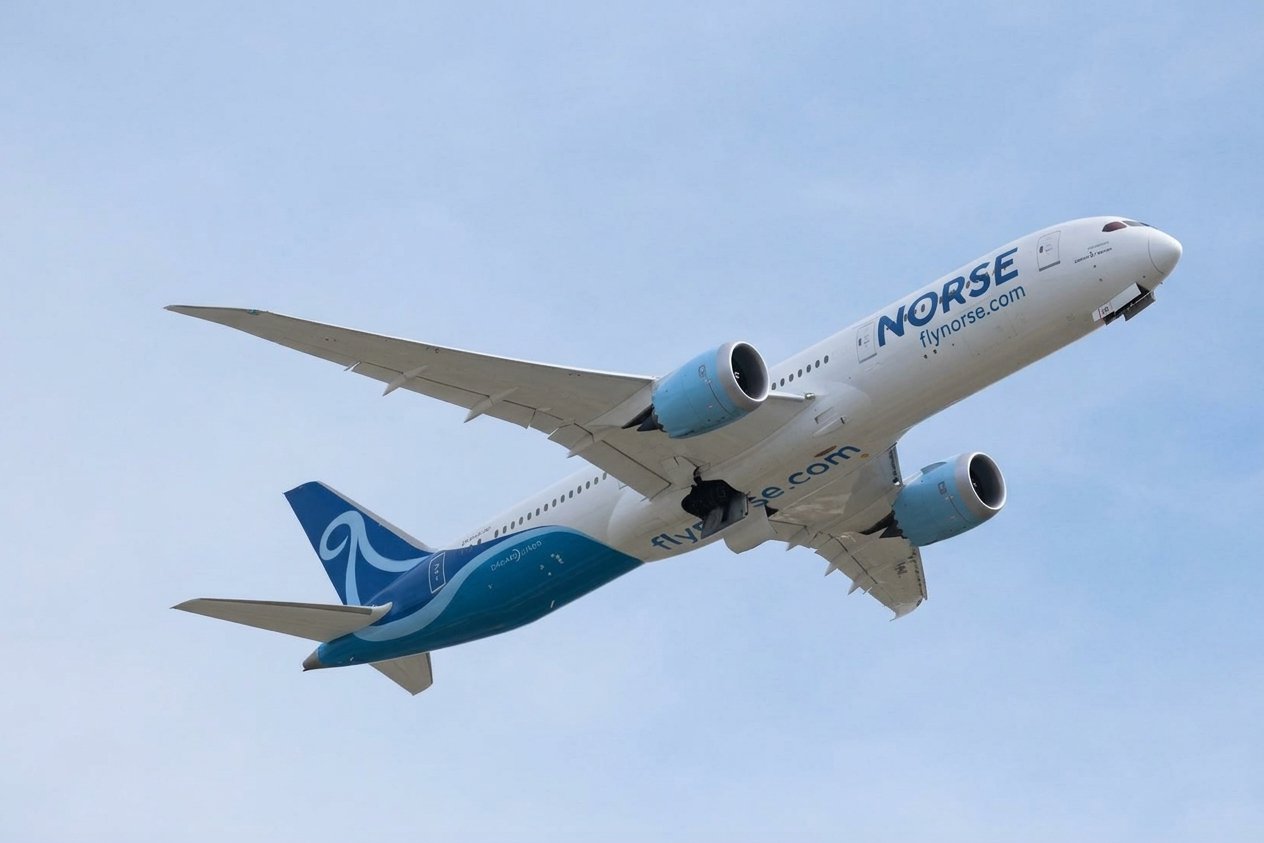
Travelers who have relied on Norse Atlantic Airways for low-cost nonstop flights between the United States and Europe may soon have fewer options.
The Norwegian long-haul airline is continuing to reduce its U.S. network, with its New York services to London and Rome scheduled to disappear from the winter 2026–27 timetable. The changes raise fresh questions about whether the era of ultra-low-cost nonstop transatlantic flying is becoming increasingly difficult to sustain.
Norse Atlantic Is Shrinking Its U.S. Network
Norse Atlantic originally built its business around affordable long-haul flights connecting Europe and North America.
However, the airline’s current network looks very different from the one it launched with in 2022.
According to recent schedule data, Norse will suspend its London Gatwick-New York JFK and Rome Fiumicino-New York JFK services from October 25, 2026, through the winter schedule period.
The changes will leave London Gatwick-Orlando as the airline’s only scheduled U.S. route during the winter season.
That represents a major reduction from Norse’s original transatlantic strategy.
New York Loses Two Norse Routes
New York has been an important part of Norse Atlantic’s network, but both of the airline’s New York routes are now being removed from the winter schedule.
The London Gatwick-New York route and Rome-New York service had been planned to operate several times each week using Boeing 787-9 aircraft.
Aviation Week reports that the two routes represented more than 80,000 two-way seats in the winter schedule that have now been removed.
For travelers, the change means one fewer source of nonstop competition on two major Europe-U.S. markets.
Why Are Cheap Transatlantic Flights So Difficult?
Operating a low-cost airline across the Atlantic is fundamentally different from running a short-haul budget carrier.
Long-haul flights involve substantial fuel consumption, aircraft costs, airport charges, maintenance expenses and crew costs.
Norse’s own recent statements also highlight the impact of elevated fuel prices. The airline said its capacity reductions were linked to persistently high fuel costs, even while its remaining network was recording strong demand.
That creates a difficult equation for an airline trying to sell very cheap tickets.
A low headline fare may attract passengers, but the airline still needs enough revenue per seat to cover the costs of operating a long international flight.
Norse Is Focusing More on Leisure Routes
As its U.S. network contracts, Norse Atlantic is increasingly concentrating on long-haul leisure markets.
The winter 2026–27 schedule shows significant capacity between European cities and destinations in Thailand, including Bangkok and Phuket. Those routes account for a large share of the airline’s planned winter capacity.
This strategy gives Norse an opportunity to focus aircraft on routes where demand for leisure travel may be stronger.
The airline also operates services involving destinations such as Cape Town, reflecting its broader shift toward leisure-oriented long-haul markets.
Norse Is Not Leaving the Transatlantic Market Completely
Despite the cuts, Norse Atlantic is not disappearing from transatlantic aviation.
The airline is expected to continue operating London Gatwick-Orlando during the winter season.
That means travelers can still find Norse service between the United Kingdom and Florida.
The airline’s remaining network, however, is increasingly different from the low-cost U.S.-Europe model that originally made Norse notable.
Cheap Fares Are Still Available
The reduction in Norse’s U.S. network does not mean cheap international flights have immediately disappeared.
Current fare searches still show relatively low Norse fares on some remaining routes. Recent search data, for example, showed one-way fares from Orlando to London available for under $250 on certain September dates.
However, airfare changes rapidly, and the lowest advertised fare may not represent the final price after baggage, seat selection and other optional services are added.
Travelers should therefore compare the total cost rather than looking only at the headline ticket price.
What Happens to Competition Across the Atlantic?
Norse Atlantic’s shrinking network could reduce the number of low-cost competitors on some major U.S.-Europe routes.
The airline entered the market after the collapse of previous low-cost long-haul experiments, including Norwegian’s original long-haul operation. Other carriers have also struggled to make the economics of inexpensive transatlantic travel work consistently.
But low-cost transatlantic aviation has not disappeared entirely.
Airlines such as French Bee continue to operate long-haul low-cost services between the United States and Europe, demonstrating that the model can work on selected routes and under particular operating conditions.
Norse’s Business Model Is Changing
Norse Atlantic’s latest network changes suggest a significant evolution in its business strategy.
Rather than maintaining a broad network between the United States and Europe, the airline is concentrating more heavily on selected leisure markets.
The airline’s August 2026 results also showed how much its operations have shifted. Norse reported that its own-network capacity had been reduced because of high fuel prices, while its load factor remained close to 99%.
Separately, industry data showed that contract and charter flying accounted for a substantial portion of Norse’s August operations.
This combination suggests that Norse is using multiple ways to deploy its Boeing 787 fleet rather than relying solely on its original scheduled network.
What This Means for Travelers
For passengers, the biggest consequence is a smaller selection of nonstop budget flights between the United States and Europe.
Travelers who previously used Norse from New York will need to consider other airlines once the winter schedule changes take effect.
However, competition remains on many major transatlantic routes. Legacy carriers, European airlines and other low-cost operators continue to offer flights across the Atlantic.
The key difference is that travelers may have fewer opportunities to find extremely low introductory fares on nonstop services.
The Future of Cheap Transatlantic Travel
Norse Atlantic’s latest reductions highlight the challenge of maintaining a low-cost business model on long international routes.
The airline’s original concept offered travelers the possibility of crossing the Atlantic for prices that were sometimes dramatically below traditional airline fares.
But rising operating costs, fuel prices, changing demand and the economics of long-haul aviation can make that strategy difficult to maintain across a large network.
Norse is now moving toward a more focused model centered on leisure destinations.
For travelers, that means cheap transatlantic fares are not necessarily disappearing altogether—but some of the most aggressive low-cost options may become harder to find.
What do you feel about this post?

Like

Love

Happy

Haha

Sad